Use cases
The digital twin of the trilateral Wadden Sea in the coastal areas of Germany, the Netherlands, and Denmark can be used for a variety of applications that require comprehensive long-term data on bathymetry, sedimentology, hydrodynamics, and morphodynamics.
The integration and analysis of extensive, consistent data enables well-founded statements to be made about physical processes and developments in this important World Heritage ecosystem.
All analyses derived from numerical modeling are freely available, referable, and findable as annual average tidal parameters in accordance with FAIR principles. The data products and their metadata can be downloaded via the Data viewer.
Here are some scenarios involving the use of TrilaWatt data products in different contexts:
- Supporting scientific research by providing a wide range of data and simulation options.
- Conducting long-term studies, analyzing environmental changes, and researching hydrodynamic and ecological processes.
1. Where do mudflats begin in the Wadden Sea?
3. Reference data and web GIS for MSFD reporting
4. New tools and data for routing cables and pipelines in the Wadden Sea
| 1. Where does mudflats begin in the Wadden Sea? |
|---|
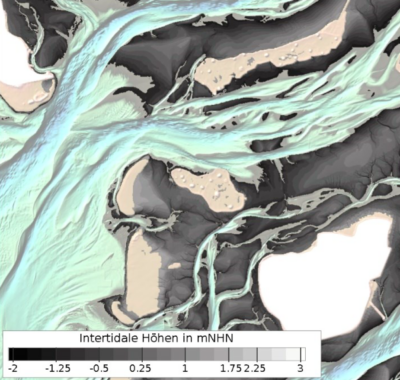
The tides in the German Bight mean that the boundaries of the mudflats vary in terms of space and time. Their characteristics and course change on daily, monthly, annual, and decadal time scales. In addition, these processes are overlaid by medium- to long-term changes in tides and bathymetry.
The annual mean mudflat boundaries can be determined from the calculations of the digital twin for the course of annually averaged high and low water lines, together with annual bathymetry.
In this use case, data from the TrilaWatt project was used to determine the annual mean extent of the mudflats in 2020. The intertidal area is thus a result of the intersection of bathymetry and annual mean high tide and low tide data from the numerical model. New data products for the topographical description of the tidal zone were derived from this work.
| 2. Web GIS-based habitat classification. Presentation of the parameter intersection calculator (PANDA) |
|---|
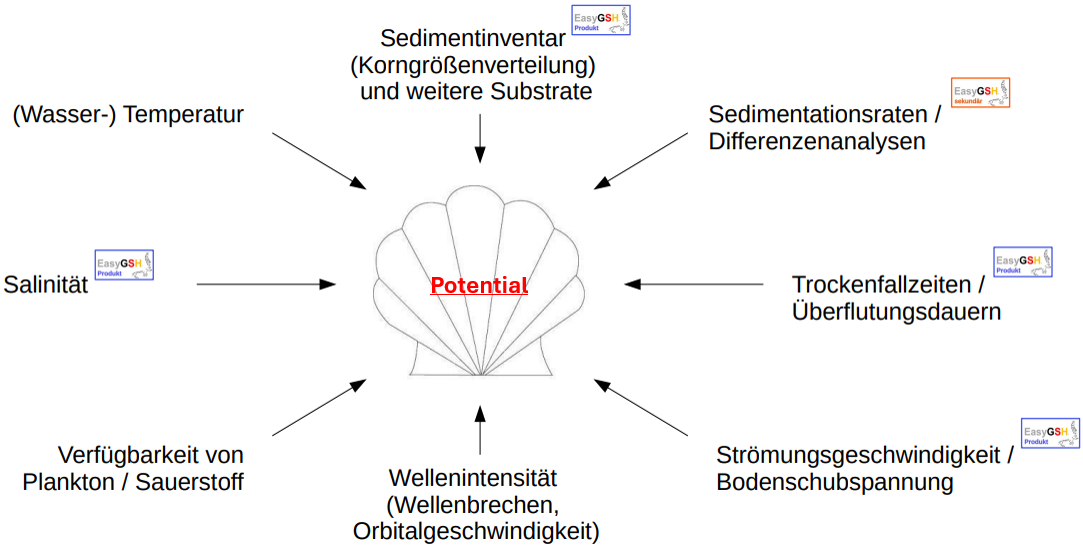
The TrilaWatt consortium has collaborated with a working group from the German administration to support German and European reporting requirements with data analyses, e.g.:
- Support in the planning and evaluation of coastal construction and development projects
- Simulation of the potential environmental impact of construction projects and coastal dynamics as a basis for sustainable decisions
| 3. Reference data and web GIS for the MSRL reporting system. |
|---|
The TrilaWatt consortium has collaborated with a working group from the German administration to support German and European reporting requirements with data analyses, e.g.:
- Support in the planning and evaluation of coastal construction and development projects
- Simulation of the potential environmental impact of construction projects and coastal dynamics as a basis for sustainable decisions
| 4. New tools and data for routing cables and pipelines in the Wadden Sea |
|---|
The laying of cables for offshore wind farms or pipelines requires detailed knowledge of bathymetry and morphodynamics near the coast, as severe erosion can jeopardize this critical infrastructure. With feedback from the North Sea Energy program (https://north-sea-energy.eu), a web-based WPS functionality has been developed to estimate the deepest bathymetric value from the database along a user-defined transect, thus assisting in this critical task. The data required for optimal planning of the construction process, such as water level, current, and sea state, are also available.
| 5. Tidal energy as a resource |
|---|
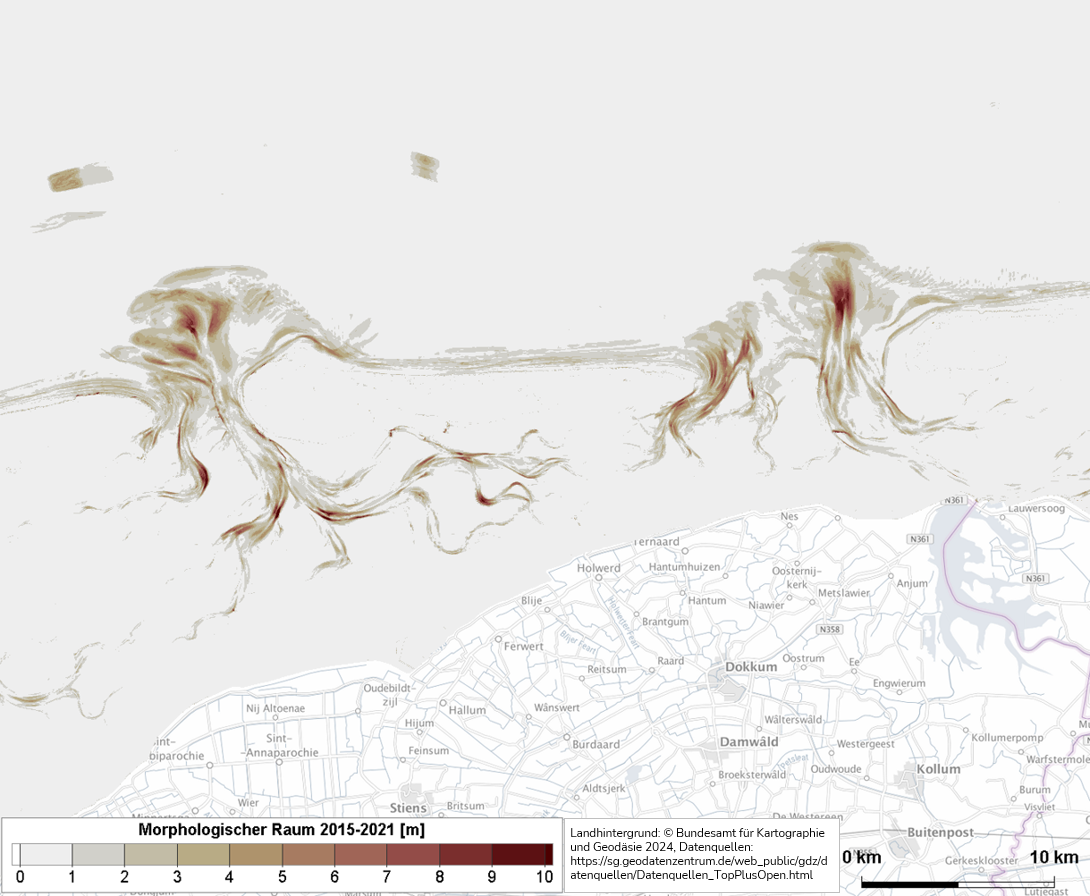
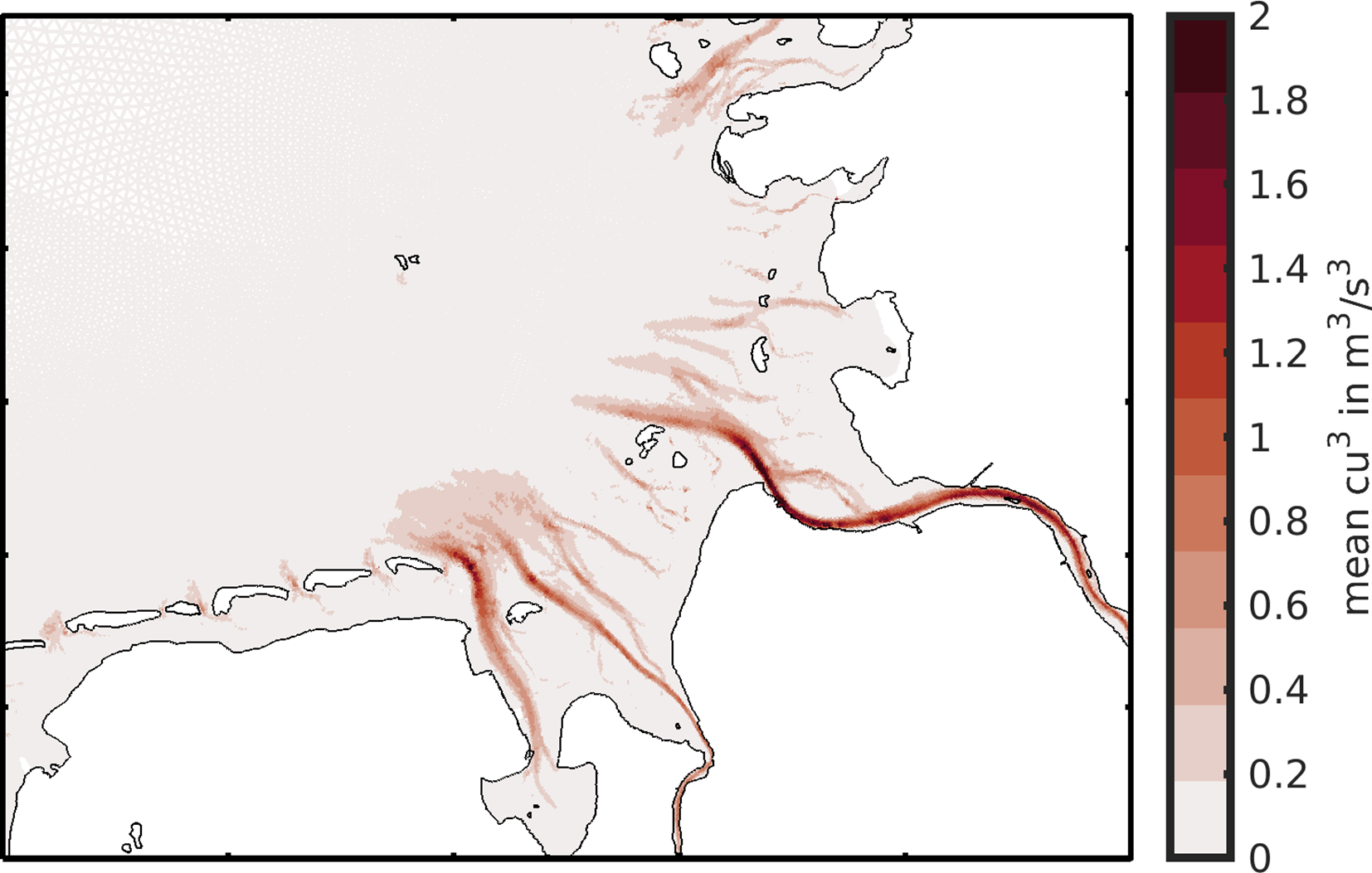
Tides occur as long-period surface waves on our oceans as a result of the periodic and constant gravitational forces of the Earth, Moon, and Sun. In the Wadden Sea, tides are predominantly semi-diurnal and mesotidal, which is why researchers have recently investigated tidal energy as a promising supplement to conventional power supply (Alday and Lavidas, 2024; Korte et al., 2024).
To support this research, additional data products were developed as part of this TrilaWatt use case to better assess the tidal energy potential. Literature: Lepper, R.; Plüß, A. (2024): Tidal energy as a resource. https://doi.org/10.18451/trilaw_2024_03.
| 6. Tide-based runtime shift for optimizing overflights |
|---|
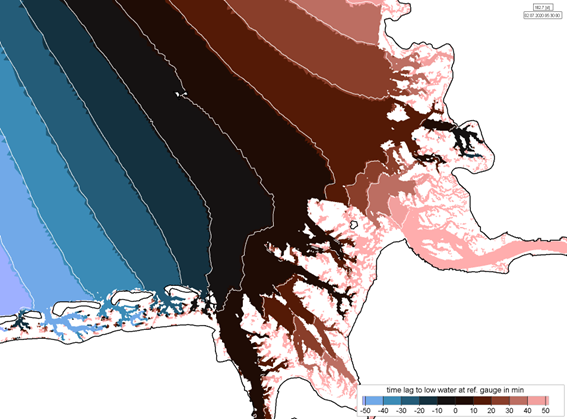
Laser scanning aerial surveying (ALS) is an established and efficient method for large-scale acquisition of elevation data with high accuracy. In the German Wadden Sea, ALS is frequently used in annual measurement campaigns in the Outer Elbe area. However, due to water turbidity, surveying below the water surface is challenging for laser scanning instruments.
Therefore, aerial elevation surveys provide the best results, especially in temporarily dry areas such as mudflats or salt marshes. In order to maximize the spatial coverage of an aerial survey, the spatially variable arrival times of low tide were derived from numerical model data in this use case in order to obtain the optimal planning of a flight route with regard to minimum water levels.
Literature: Lepper, Robert (2024): Tide runtime shift for optimizing overflights.
Social Contact